%20-%20WO%20BG.png)
[#5] The Three Hidden "Doom Loops" Wall Street is Desperately Trying to Ignore
.jpg/v1/fill/w_320,h_320/file.jpg)
Updated: Mar 12
This monthly briefing is available in three formats. You will find the embedded video and the detailed text right here on this page, or you can listen to the audio podcast on your favorite platforms (Spotify, Apple Podcasts, etc.).
As a contrarian investor, the most dangerous phrase you can hear is, "Everything is fine."
Right now, the mainstream financial media is cheering on resilient narratives and hoping for quick resolutions to global conflicts. But my pattern recognition models are flashing structural warning signs we haven't seen since the lead-up to the 2008 Great Financial Crisis (and in some cases, the 1970s stagflation era).
For individuals managing their own portfolios, relying on lagging indicators, heavily revised government data, or "buy the dip" narratives is a recipe for disaster. Let’s connect the dots under the radar. We are currently watching three distinct "doom loops" converge:
A Geopolitical Energy Shock: The "actuarial blockade" of the Middle East and global supply chain breakdown.
A Systemic Financial Crisis: The shadow banking liquidity freeze and hidden defaults in the $2 trillion Private Credit market.
A Domestic Economic Collapse: The "Biden Moment" in the labor market and a rapid slowdown in economic growth.
Here is the deep dive into these structural fractures, how the "dumb money" is walking blindly into a trap, and how you can use professional options strategies to secure peace of mind.
TIMESTAMPS
0:00 The Hook: Retail is Buying the Oil Trap
1:04 The Actuarial Blockade in the Strait of Hormuz
2:28 A Global Resource Crisis & 1970s Stagflation Parallels
3:57 The Generational Rotation & The Gold Paradox
5:04 The "Biden Moment" & the 6-Sigma Jobs Miss
6:41 Wall Street is Doing Another AIG (Private Credit Crisis)
9:45 The Retail Trap & S&P 500 Internal Turmoil
10:58 Technical Breakdown: S&P 500 Loses Key Moving Averages
12:01 The Macro Playbook: Options, Hedging, & Cash
14:04 Bitcoin's Status & Final Warning
1. The Oil Illusion & The Actuarial Blockade
Right now, the entire world is staring at the Middle East, watching oil blast past $100 a barrel, and hanging onto every single headline. We are seeing messages that the war could be over soon, and retail traders are treating this like a quick dip-buying opportunity.

But retail is walking blindly into a massive trap. They are treating a structural global crisis like a short-term meme stock. Look at the data: The USO ETF just shattered its all-time daily volume record with $7.6 billion traded by mid-day on Monday, March 9th, completely dwarfing the 2020 and 2022 panics. Furthermore, call volume on oil is at a 10-year high.


Literally every retail trader is longing oil right now, betting on the escalation. This is an incredibly crowded trade. When a trade gets this crowded, any headline hinting at a "ceasefire" or "deal" will cause a violent, rip-your-face-off mean reversion as these calls get liquidated.
But here is the terrifying reality the market is mispricing: Even if the "hot" war ends tomorrow, the global supply chain is broken. This isn't a 2-to-4-week event. The Strait of Hormuz hasn't just been hit by missiles; it has been hit by an actuarial blockade. London reinsurers, bound by Solvency II capital requirements, simply cannot underwrite ships passing through that region. Even after a ceasefire, it takes 6 to 18 months for the insurance market to rebuild risk models and commit capital again.
You can see the panic in the physical market. The 3-month calendar spread for WTI just exploded to a $13 premium for immediate delivery. That is a level of pure desperation we have not seen since the 2022 invasion of Ukraine and the 2008 crash. Asian countries are paying massive premiums to take over ships today because they are cut off.


And the U.S. cannot easily bail out the global market. The Strategic Petroleum Reserve was drained over the last few years and sits at multi-decade lows. We went into a geopolitical energy shock with half-empty emergency tanks.

A Global Resource Crisis & Generational Rotation
This goes far beyond oil. When you shut down the Middle East, you aren't just shutting down gasoline. You are shutting down LNG to Taiwan, which threatens global semiconductor production. You are shutting down the natural gas required for the Haber-Bosch process, which likely means a global fertilizer and food crisis within three to six months. We are seeing civilian survival infrastructure targeted (like desalination plants) and power grids. When survival is on the line, global trust evaporates, and nations begin hoarding.
The parallels to the 1970s are absolutely staggering: Oil prices going parabolic. War escalation in the Middle East. The U.S. economy locked in a stagflationary phase. In July 2008, a similar oil and inflationary spike sent CPI to 5.6%, which was the exact "straw that broke the camel's back" right before the deflationary banking crash.

We are witnessing a generational rotation. The technology sector's weight in the S&P 500 is peaking, while the combined weight of Energy and Materials sits near record lows. During the Dot-Com bubble, Tech fell from 35% to 15% in two years, kicking off a decade-long bull market in hard assets. The exact same gap is widening today.

But short-term liquidity is a different animal. Look at Gold. With this level of war and inflation, Gold should be printing massive new highs. Instead, we just saw a $2.91 billion outflow from the GLD ETF: the largest in a decade.
Why? While we can only deduce the exact mechanics right now, the usual suspect in a severe liquidity crisis is that institutions sell what they can, not what they want. There could also be heavy redemption requests (conversion of GLD ETF shares into physical gold), which could explain why the spot price hasn’t tanked despite the massive paper "selling." Furthermore, a "Dollar Squeeze" could be forcing foreign nations and over-leveraged funds to dump paper gold to raise U.S. dollars to meet margin calls related to $100+ oil or other losing bets. It is particularly odd that Gold hasn’t spiked massively during the past two weeks, especially with the physical metal being drained globally. I strongly believe that the paper ceiling will eventually snap.

2. Wall Street is Doing Another AIG
The second doom loop is the black swan event that the central banks are quietly panicking over. Wall Street is currently doing another AIG, and it is happening right under our noses in the $2 trillion Private Credit market.

Here is the full YouTube video: https://www.youtube.com/watch?v=k9UgUTt0u-Y
In 2008, AIG almost brought down the global financial system because they were hiding toxic subprime mortgages on their balance sheet. Today, the titans of Private Credit have recreated that exact same systemic risk, and it affects the most conservative investors: retirees.
Over the last decade, giant alternative asset managers like Apollo and Blue Owl figured out a brilliant regulatory arbitrage. They went out and bought life insurance companies. They took "Main Street" money (the conservative capital from people buying safe, stable annuities for their retirement) and they used it as the permanent funding base for their high-risk, private equity tech loans. They domiciled these entities offshore to dodge U.S. regulators, and they stuffed these conservative insurance portfolios with toxic waste.
And what happens when the tech and software companies they loaned money to can't pay? Because right now, for the first time, Chief Information Officers are telling their CEOs to slash their CapEx budgets. This is the last thing anyone would expect a CIO to say!

Instead of admitting the loans are bad, the private credit industry went "full Ponzi." Seventy percent of their "exits" are just rolling dead assets into new funds or trading junk with each other to manipulate the price. Distributions to investors have crashed to barely double digits.

But the illusion is finally breaking. After the first major warning with Blue Owl on Feb 26th, we are now starting to see the first signs of panic at much larger and systematically important firms like BlackRock, which is now taking private loans and marking them from 100 cents on the dollar straight to zero overnight. There is no gradual downgrade. It just evaporates.

And this is why the panic is starting. For the first time in history, BlackRock is halting withdrawals on its $26 billion flagship fund.

And Blackstone’s massive BCRED fund ($82B) just got hit with a 7.9% redemption tsunami. The gates are slamming shut. Retail and institutional money is trapped in a burning building. When this contagion hits the insurance providers, it will make 2008 look tame.

3. The Domestic Decay & The "Biden Moment"
While the world is distracted by the Middle East and Wall Street desperately hides its toxic debt, the U.S. domestic economy is quietly imploding in slow motion. We are rapidly approaching what some analysts are calling the "Biden moment": the point where the lagging, massaged government data catches up to the brutal reality of the street.
The narrative of a booming U.S. economy is dead. The Atlanta Fed GDPNow forecast just plummeted to 2.1% for Q1. The growth illusion is fading, and the labor market is flashing a massive red warning sign.

The February Non-Farm Payrolls (NFP) report wasn't just bad; it was a statistical six-sigma miss. The official print was negative 92,000 jobs, printing 83,000 below the absolute lowest Wall Street estimate.

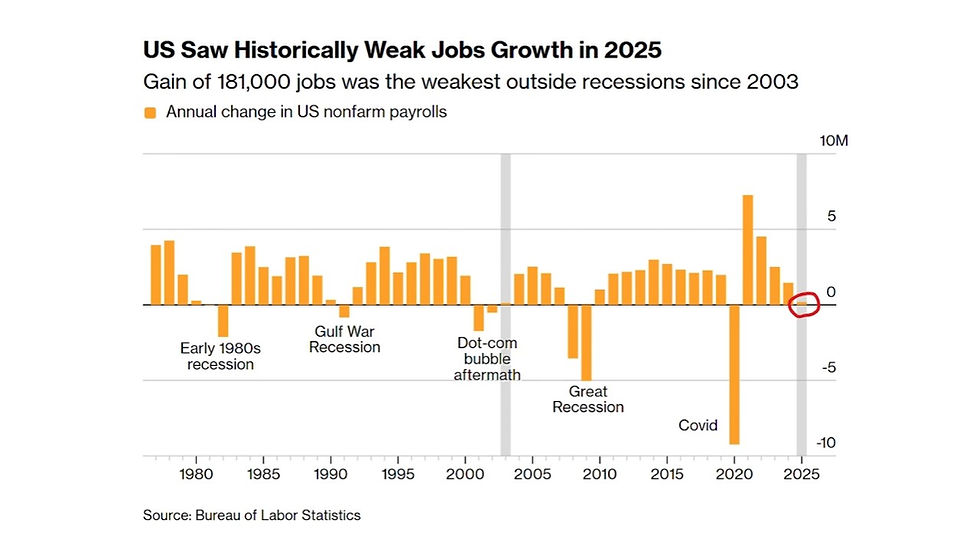
But it gets worse under the hood. The Household survey showed an even more catastrophic loss of 185,000 jobs. The true unemployment rate is being artificially suppressed by people dropping out of the labor force. If you look at the chart showing the heavy downward revisions for all of last year, the U.S. effectively created zero net jobs in 2025. We have not seen this level of labor stagnation since the aftermath of the dot-com recession.
4. Market Fragility & The Retail Trap
How is the stock market reacting to a global energy shock, a shadow banking crisis, and a labor market collapse? Retail is buying the dip.
Retail equity purchases on down days are running at the highest level on record, over 100% higher than during the 2021 meme stock frenzy. Retail is essentially providing exit liquidity for the institutions who are quietly rushing for the doors.

On the surface, the S&P 500 volatility looks completely compressed. But under the hood? Complete turmoil. Only 101 out of 500 stocks have moved less than 5%, and over 120 stocks in the index have moved more than 20%, showing massive, violent sector rotation as the smart money dumps expensive software and tech.

The technical dams are breaking. The S&P 500 just closed below its 20-week moving average and its 100-day moving average. The last time we saw a breakdown like this, it led to an 18% dump in the broader market.

Even Ed Yardeni, one of the most famous perma-bulls in financial history, just threw in the towel. He slashed his odds of a market melt-up from 20% to just 5%, and raised the probability of a stock market meltdown from 20% to 35%.

How to Position Yourself: Peace of Mind in a Chaotic Market
So, how does macro capital navigate a storm of this magnitude? The absolute golden rule right now is that strategy before the crash always beats panic during the crash. This is even more important in a headlines-driven market characterized by extreme volatility and uncertainty. Because the most important thing is not gains but the protection of capital, remember that Cash and short-dated T-bills can be a strategic position, despite what people who don’t have your best interests at heart might tell you.
The rotation out of digital financialization and into real-world commodities, energy, and defense is likely a multi-year thesis. But if you are making directional bets on volatile assets like oil right now, naked positions are incredibly dangerous due to headline risk.
For instance, if a macro trader wants to participate in another melt-up on oil, they are forced to use vertical spreads to reduce risk. In simple terms, instead of risking $1,000 on a simple call option betting that oil will run above $120, executing a vertical spread ($120 to $150) allows them to reduce the capital at risk to just $400. This spread has a maximum potential gain of $3,000, that represents a 7.5x risk/reward ratio (much higher than the usual 2-3x ratio). This is how institutions define their risk.
For hedging, standard insurance (like buying simple put options near the current price) is becoming prohibitively expensive because volatility is so high. Instead, institutions often use collars to finance their downside protection. At least the "doomsday insurance" (deep out-of-the-money puts) remains relatively cheap.
And finally, a note on Bitcoin. It has held up incredibly well as a neutral asset. However, if the traditional markets break and private credit gating forces massive institutional margin calls, highly liquid assets like Bitcoin and paper Gold are often the first things sold to raise emergency dollars. Be prepared for the potential of severe flash crashes if the broader system deleverages.
The data and frequency of 6-sigma events are telling us that the "nothing ever happens" complacency era is over. Stay vigilant, look beneath the surface, and don't get caught being the exit liquidity for institutional investors.
If you are ready to stop relying on mainstream narratives and want to learn how to actively protect and grow your wealth using professional-grade options strategies, let's talk.
Thanks,
Nico de Bony

If you found this briefing helpful, feel free to share it. For those ready to build a defensive process, the links to my training are below.
Watch my Free Masterclass to understand the 5 core hedging strategies.
Watch the Practical Demo to see me execute these trades live.
If you want to master this, check out my Self-Paced Course
or apply for one of the few remaining spots in my 1-on-1 Coaching.


