%20-%20WO%20BG.png)
The SpaceX (SPCX) IPO Exit Liquidity Trap
.jpg/v1/fill/w_320,h_320/file.jpg)
Updated: Jun 11
YouTube video published 2026/06/11
This weekly briefing is also available in podcast formats on your favorite platforms (YouTube, Spotify, Apple Podcasts, etc.).
Introduction
This Friday, June 12th 2026, the financial world will witness what is being advertised as the investment opportunity of the decade: the initial public offering of Elon Musk’s SpaceX under the ticker symbol SPCX on the NASDAQ.
The media hype machine is entering a state of absolute mass euphoria. But as your financial coach, my job is to help you look past the covers of magazines and look directly into the structural machine of Wall Street. When you analyze the 277-page S-1 filing, the leaked internal financials, and the current macroeconomic context, a completely different reality emerges.
This is not a traditional startup listing designed for price discovery or to provide early-stage appreciation to retail investors. This is a highly orchestrated, multi-trillion-dollar mechanics game engineered to use your passive retirement accounts as exit liquidity for insiders.
Below is an exhaustive, standalone breakdown of every red flag, structural mechanism, and macroeconomic headwind you must understand before the opening bell this Friday.
1. The Reality of an Insane Valuation
The pure scale of this offering is designed to overwhelm the market. You need to understand these numbers in their proper historical context:
The Largest IPO in Human History: At its targeted capital raise of up to $75 billion, SpaceX is asking the public market to swallow an amount roughly 2.5 times larger than the previous historical record holder, Saudi Aramco, which raised $29 billion in 2019. It is roughly four times what Facebook raised at its debut.
Bigger Than the Public Space Industry: The targeted valuation floor of $1.8 trillion (originally floated at $2 trillion in April before being revised downward due to institutional pushback on its initial financials) means this single company is valued higher than the entire current public space index complex combined, in a way similar to TESLA’s valuation vs the whole auto industry.
Insane GDP Proportions: At $1.8 trillion, SPCX will debut at an eye-watering 6%+ of US GDP. To put that into perspective, when Meta (Facebook) went public, it was considered a massive systemic event, yet it represented a mere 0.6% of GDP.
The "Lottery Ticket" Pricing Model: This $1.8 trillion price tag is calculated on an absurd 100x price-to-sales (P/S) ratio. Wall Street is achieving this number by valuing three entirely separate industries (Aerospace, Telecom, and Artificial Intelligence) at a maximum premium, assuming absolute operational perfection and flawless execution far into the future.
The Morningstar Reality Check: Institutional analysts are already calling bluffs. Morningstar’s independent equity analysis values the company at just $63 per share, a staggering 53% lower than the expected $135 per share implied by the high-end underwriting groups.
The Walmart Disconnect: To understand how distorted this is, compare SpaceX to Walmart (WMT), which commands a similar $1.8 trillion market cap. Walmart is highly profitable and generates roughly 10 times the revenue of SpaceX. SpaceX, conversely, is completely unprofitable and operates at barely 10% of Walmart's revenue baseline.
No Longer a Startup: True startups can occasionally justify high multiples because their small scale allows for exponential, triple-digit growth. SpaceX is already 24 years old. Because it is a massive, mature industrial giant, reaching the future growth rates required to justify a 100x sales multiple is fundamentally harder, even if everything goes exactly according to plan.
The Hype Fractal: Financial history dictates an unyielding rule: The more an IPO is hyped and financialized during its private stages, the harder it falls once it hits public reality. Think back to the climax runs and subsequent collapses of Uber, Aston Martin, or Coinbase.


2. Unmasking the Inside Mechanics & Artificial Scarcity
The trading debut of SPCX is not going to be a clean reflection of organic supply and demand. It has been tightly engineered through specific market mechanics:
Artificial Scarcity via Low Float: The underwriters are creating a massive supply squeeze by floating a tiny fraction (only 1% to 5%) of the total corporate equity on Friday. By keeping the public float artificially low, they ensure that even a modest amount of buying pressure will send the share price rocketing on day one, generating the euphoric media headlines they need.
The Illusion of Being "Oversubscribed": Mainstream financial media is bragging that the order book is "oversubscribed by 2x to 4x." Do not be fooled: this is exceptionally weak for a highly anticipated mega-cap listing. Saudi Aramco was 4.6x oversubscribed , and recent tech listings routinely see oversubscription rates between 10x and 120x. In fact, demand is soft enough behind closed doors that Donald Trump publicly floated the idea that the US Government might step in to buy equity stakes in domestic AI companies to shore up capital.
The Passive Index Fund "Force-Feeding" Cascade: This is the most dangerous component for your personal portfolio. Index providers like NASDAQ and FTSE have quietly modified their guidelines to significantly shorten their inclusion windows. Under the newly implemented NASDAQ "fast track" rules, SPCX can bypass the traditional 90-to-180-day cooling period and be force-included into the Nasdaq 100 index in as little as 15 trading days.
The S&P 500 Profitability Battle: While the S&P 500 index committee heavily debated waiving its strict trailing profitability requirements specifically to allow SpaceX a fast-track entry, they officially announced on June 4th that they will maintain their standards. While this protects S&P 500 passive holders temporarily, the Nasdaq 100 fast-track means passive ETFs (which manage trillions of dollars of everyday citizen retirement money) will be legally forced to automatically purchase hundreds of millions of shares of SpaceX shortly after listing, completely irrespective of price or underlying financial health. Insiders know this and are using these automatic, price-insensitive retirement fund buyers as their ultimate exit doors.
Leveraged ETF Inundation: In a sign of peak speculative frenzy, financial institutions have already scheduled several leveraged long and short SPCX ETFs to debut on the exact same day as the IPO, maximizing intraday retail gambling and expanding structural delta-hedging volatility.


3. Red Flags and Corporate Shenanigans
When you pull back the glossy aerospace facade, the official S-1 filing reveals deep operational fractures, legal restrictions, and highly questionable accounting maneuvers:
Contradictory Financial Disclosures: There is a glaring material discrepancy in the registration documents regarding a crucial $45 billion contract with Anthropic. The S-1 filing frames this as a guaranteed, multi-year recurring revenue stream ($15B/year) designed to back up growth models. However, Elon Musk has publicly stated in recent interviews that the deal is actually a highly flexible, short-term compute lease containing strict cancellation provisions. This direct contradiction calls into question the entire reliability of the company's financial forecasting.
Severe Debt and Liquidity Risks: This IPO is not an offensive expansion; it is a defensive bailout. SpaceX is sitting on an explosive $20 billion bridge loan that matures as a massive balloon payment in September 2027. Because the company's operations are heavily cash-flow negative, they lack the organic operating cash flow to service or repay this debt. The $75 billion capital raise is structurally mandatory simply to avoid a catastrophic default next year.
Totalitarian Corporate Governance: SpaceX utilizes a dual-class share structure with no sunset provisions. Insiders hold super-voting Class B shares, concentrating 85.1% of total voting control directly in the hands of Elon Musk. Public shareholders will have zero say in strategy, executive compensation, or corporate direction.
Stripping of Legal Rights: To buy shares of SPCX, the prospectus mandates that investors explicitly waive their fundamental rights to jury trials and class-action lawsuits. If you are defrauded or if accounting anomalies emerge, your only recourse is mandatory private arbitration.
The Venture Capital Exit Trapdoor: While C-suite corporate executives are locked up under a standard 366-day window, early venture capital funds holding shares through Special Purpose Vehicles (SPVs) have negotiated a highly aggressive, progressive unlock schedule. This allows institutional insiders to dump up to 20% of their holdings into the public market as early as November 2026 if the share price hits specific minor premium targets, using early retail buyers as pure exit liquidity.
The Three-in-One Conglomerate Profile: SpaceX is pitched as a unified entity, but its three distinct business units have radically different, deeply concerning profiles (It is the equivalent of buying 3 cars, a ferrari and 2 regular cars, for the price of 3 ferraris).
Connectivity (Starlink): The sole profitable cash cow of the business, generating $1.19 billion in Q1 2026 operating profits. However, internal tracking shows its global subscriber growth is beginning to plateau as it faces real-world total addressable market limits.
Space Launches: The legacy rocket business captures the public imagination but accounts for only 5% of total corporate revenues and is actively bleeding cash , posting a brutal $4.3 billion loss in Q1 2026 alone due to the endless, uncapitalized R&D burn of the Starship program.
Artificial Intelligence (xAI): A complete operational disaster. In Q1 2026, the AI division lost a staggering $2.47 billion on a measly $818 million in revenue. Its operational loss ratio has deteriorated rapidly from 2:1 last year to an unsustainable 3:1 this quarter.
Misleading EBITDA Math and Artificial Launches: To inflate Anthropic's financials as a launchpad for the SpaceX valuation, Musk granted Anthropic massive price discounts for compute capacity throughout May and June under the guise of an "infrastructure ramp-up." This will allow Anthropic to temporarily record a positive EBITDA for Q2. This is intentionally misleading, not only because the discount window is strictly limited, but because EBITDA completely strips out the massive, multi-billion-dollar infrastructure amortization costs required to run these server clusters.
Circular Financing Shenanigans: The entire sector continues to prop itself up through a closed-loop accounting machine, where they all benefit from the artificially boosted valuations in AI startups.


4. Broad AI Sector Red Flags: The Cracks Are Expanding
The SpaceX listing is being rushed to the market precisely because the broader artificial intelligence bubble is beginning to show severe structural vulnerabilities:
The SoftBank Collateral Failure: In a shocking under-the-radar credit development, SoftBank recently attempted to secure a modest $6 billion institutional bank loan using its massive private equity stake in OpenAI (internally valued at a lofty $100 billion) as direct collateral. Wall Street commercial banks flatly rejected the collateral asset, refusing to underwrite the loan against unlisted AI private shares. This signals that the smart money banking desks know these private valuations are completely illiquid and vastly overstated.
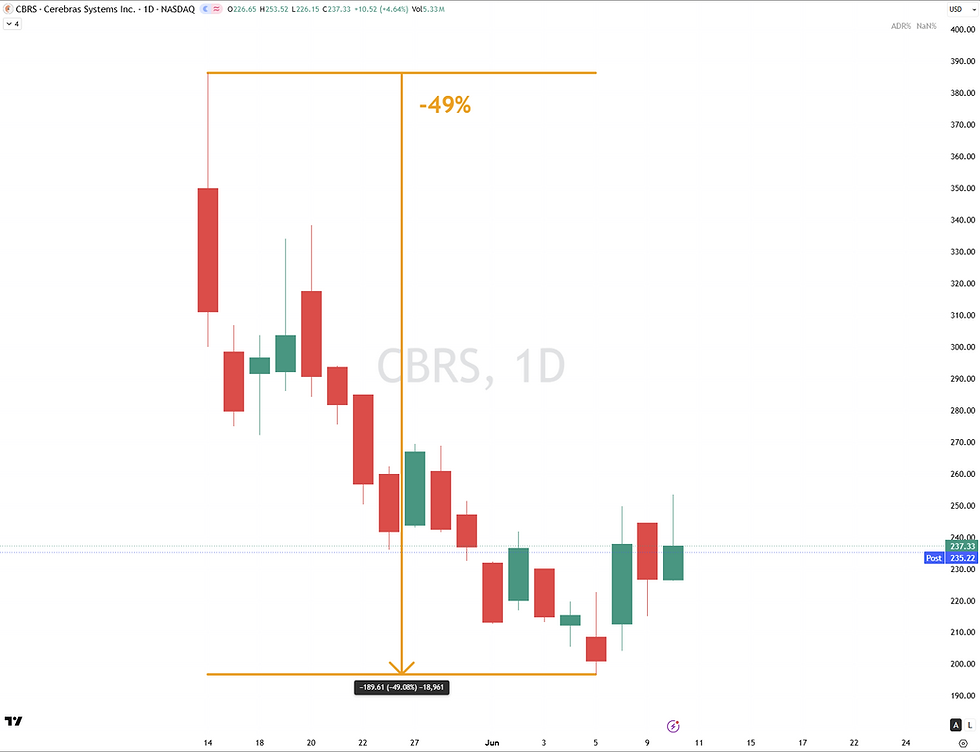
The Dismal CBRS Precedent: Cerebras (CBRS), the most recent AI hardware IPO to hit the public markets, has performed miserably post-listing with a -49% from peak on IPO day to its all time low, serving as an ominous warning signal for new capital trying to chase the hardware narrative.
The Death of the AI Subsidy Era: Despite a desperate need to project infinite demand, AI infrastructure labs are hitting a hard financial ceiling. The era of heavily subsidized, flat-rate enterprise pricing is dying in real-time. Labs are aggressively moving to usage-based, per-token pricing models because inference costs are completely untenable.
Corporate AI Budget Exhaustion: Major enterprise tech users are quietly mutinying. Microsoft completely canceled its internal enterprise coding licenses for Claude Code after token-based billing made the day-to-day cost mathematically unjustifiable for their engineering teams. Similarly, Uber’s CTO issued an internal corporate warning memo revealing that the company had completely blown through its entire annual 2026 AI infrastructure budget in just the first four months of the year due to uncontrolled token usage. Corporations are scaling back AI deployments because there is zero verifiable return on investment (ROI) to justify the ongoing capex.



5. Dangerous Macroeconomic Headwinds
SpaceX is sprinting to the public markets because its backers know the global macroeconomic landscape is turning highly unfavorable for speculative risk assets:
The Liquidity Vacuum Effect: The sheer scale of the SpaceX listing, combined with the impending Q4 capital demands of OpenAI and Anthropic, will require an astronomical $200 billion in public liquidity. Because there is no new net money entering the system, passive index funds will be mechanically forced to execute massive liquidation sales of their existing, highly crowded "Magnificent Seven" and semiconductor leaders (Nvidia, Broadcom, Apple, Microsoft) simply to raise the cash required to buy SPCX upon inclusion. This will act as a structural liquidity vacuum, threatening to drag down the entire S&P 500 and impacting portfolios that do not even hold SpaceX individual shares.
The Rocky Kevin Warsh Era Begins: The Federal Reserve has officially entered the Kevin Warsh era. Operating under shifting mandates, Warsh has explicitly signaled a desire to transition the Fed toward a single-mandate focus centered strictly on price stability and aggressive balance-sheet reduction. While Warsh structurally wants to cut interest rates, the current reality of reaccelerating pipeline inflation (with PPI running at a hot 6% year-over-year) and a completely unyielding, dragged-out war in Iran means the market is actively pricing in potential interest rate hikes rather than cuts. Speculative tech multiples cannot survive a "higher-for-longer" policy shift.
6. The Active Investor Playbook: To Buy or Not to Buy?
Retail investors are currently entering this market at maximum leverage, driven by FOMO, while institutional "Smart Money" has established record-high net short exposure and black swan tail-risk hedges. SpaceX is valued on the assumption of absolute perfection in a world that is fundamentally highly imperfect.
Here are several key factors to consider for your own decision-making process:
Check Your Current Passive Exposure: Avoid doubling your risk unnecessarily. If you hold common passive index ETFs like the QQQ (Nasdaq 100), the automated system will force-include SpaceX shares into your portfolio within the next 15 to 45 days. You already carry the structural downside risk of this asset class, meaning you do not necessarily need to expose your active capital by purchasing individual shares on top of your passive allocation.
The 90-Minute Rule: If you absolutely insist on purchasing individual shares of SPCX, it is generally recommended to abstain from any trading during the first 90 minutes of listing to allow the market to stabilize.
Fractional Entry: Historical data across major tech listings show an average correction of 15% to 30% within the 4 to 6 weeks following the IPO, once the initial euphoria fades. If you wish to build a position through disciplined tranches, you can allocate a fixed percentage of your capital and plan entries over a set time horizon (e.g., 6 to 12 months).

The Core Question: Ask yourself this essential macroeconomic question. If these orbital technologies and AI conglomerates were truly as paradigm-shifting and endlessly profitable as their marketing claims, why are the founders and venture capitalists in such a desperate, highly orchestrated rush to rewrite index rules, shorten inclusion windows, and liquidate their positions at the exact moment this is supposed to be "just the beginning"?

Nico de Bony
If you found this briefing helpful, feel free to share it. For those ready to build a defensive process, the links to my training are below.
Watch my Free Masterclass to understand the 5 core hedging strategies.
Watch the Practical Demo to see me execute these trades live.
If you want to master this, check out my Self-Paced Course
or apply for one of the few remaining spots in my 1-on-1 Coaching.


