%20-%20WO%20BG.png)
[#4] Why the Smart Money Has Already Rotated. What Happens Next.
.jpg/v1/fill/w_320,h_320/file.jpg)
Updated: Mar 5

Executive Summary
If you only looked at the S&P 500 closing prices in January, you might think the "Soft Landing" is secure. You would be wrong. Under the surface, the machinery that has driven this market (specifically unlimited AI financing, "strong" labor data, and the Yen carry trade) is fracturing.
In the past 4 weeks, we witnessed three critical fractures:
A "6-sigma" crash in Silver.
A quiet implosion in Private Credit.
The revelation that 1.2 million jobs reported by the BLS in 2025 never actually existed.
This is critical because this incorrect data was used to make and justify major policy decisions, specifically the Federal Reserve’s refusal to cut rates because the economy was supposedly "strong and resilient." We are moving from a narrative of "Growth" to one of "Solvency."
Here is the contrarian analysis of what actually happened and how to position for the volatility ahead.
Note to readers: This month's companion video was designed to complement this briefing. I includes a very brief overview of some of these macroeconomic concepts, then I share my screen on TradingView for a technical analysis of Gold, Silver, BTC, S&P 500, and QQQ. You will also find a visual summary with the key screenshots for each asset at the end of this article..
1. The Great Rotation Is Complete: Tech is Oversold, Safety is Expensive
The mainstream headline is that investors are rotating from Tech into "Defensive" sectors like Utilities and Staples. My analysis shows this is yesterday’s news. The smart money has already rotated.
The rotation has been so aggressive that we have reached a statistical extreme. The "safe" trades (Utilities, Staples, Gold Miners) are now technically overbought and crowded, while the "risky" trades (Mag 7, Software) are deeply oversold. A continuation of this bull market can only happen if Tech participates, and current levels suggest we are near a tactical bounce for Tech, not a sell signal.

However, the reason for this rotation remains valid: the credit plumbing powering the AI boom is clogging up.
The Oracle Warning: Oracle sought to raise $45 - $50 billion in 2026 to fund data centers but notably avoided full debt financing, signaling that credit markets are tightening even for tech titans.
The Private Credit "Cockroach": The "safe" yield of private credit is revealing its risks. BlackRock’s TCP Capital slashed its Net Asset Value (NAV) by 19% after non-accrual loans spiked, and Apollo took a 100% loss on a "protected" loan.
The Takeaway: Smart money has already rotated. Chasing the defensive trade here is buying the top. Watch for a mean reversion where Tech leads the next leg, or everything corrects together.
2. The Labor Market Gaslighting: Anatomy of a Lie
The Federal Reserve justified "higher for longer" rates by pointing to a "strong" labor market. We now have proof this was a fabrication based on faulty modeling. To understand the scale of this deception, look at how the data was presented versus the reality:
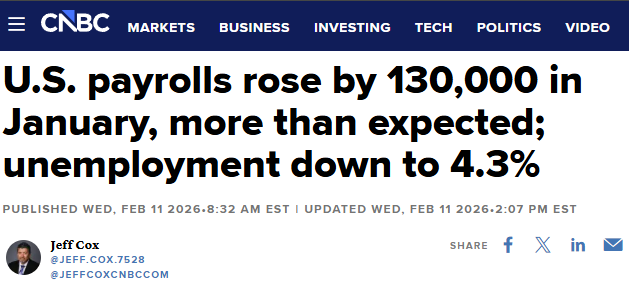
Phase 1: The Gaslight (The CNBC Headline): On February 11th, the BLS released data that CNBC and mainstream outlets immediately hailed as positive. They focused entirely on the "surprise" January job growth, celebrating a headline number that beat expectations. This celebration ignored the fact that the same report contained massive downward revisions for the entirety of 2025, showing how unreliable the initial print has become.
Phase 2: The Soft Walkback (The Misleading Revision Table): To minimize the damage, the BLS put the emphasis on a discrepancy of "only" ~403,000 jobs. This is a statistical sleight of hand. It compares the final number to the previous lie, rather than comparing it against the original claim.
Phase 3: The Reality (The Cumulative Truth): When we do the actual math - comparing the Initial Prints (what we were told each month) against the Final Benchmark (what actually happened) - the gap is horrifying.
The Claim: The economy supposedly added 1.41 million jobs in 2025.
The Truth: It added only 181,000.
The Error: The BLS overstated labor market strength by a factor of 8x.


At this point, no data would be safer than data this wrong. It is the equivalent of a plane’s altimeter being off by 87%; it guarantees a crash.
A Note on Resilience: While these data revisions paint a concerning picture of the broader economy, my approach at OPTI Strategies relies on process over prediction. By prioritizing risk management and strategic hedging, my process is built to help investors withstand these exact macroeconomic fractures, avoiding the need to rely on perfect data from the BLS.
3. The "Leverage Singularity" & The Kevin Warsh Risk
While the consensus fears a bond market crash due to Kevin Warsh’s nomination, the specific fear regarding Warsh is rooted in his history of being "allergic to data."
The Stubborn Hawk: Warsh is viewed as dangerous not just because he is hawkish, but because he has a history of fighting imaginary inflation during actual crises. In 2008, as Bear Stearns and Lehman Brothers were collapsing and the economy was entering deflation, Warsh continued to argue that "inflation risks were real." He prioritized fighting a phantom enemy while the financial system burned.
The Trade: Despite this, short interest in TLT (Long-Term Treasuries) has hit a record 150 million shares.
Contrarian Angle: If the labor market is actually in recession (as the 1.2M job revision proves) and credit is freezing, yields must fall eventually. Warsh’s history suggests he might be late to cut, but the economic reality will eventually force his hand. The massive short positioning in TLT is fuel for a violent short squeeze rally once that pivot becomes undeniable.


4. Precious Metals: The Physical Liquidity Freeze
This month saw Silver crash nearly 40% in a single day. While many focused on the price, the real story was the breakdown in market mechanics.
Statistical Reality: Silver has a "fat tail" distribution. A 6-sigma move (statistically impossible in normal markets) actually happens in Silver about every 19 months.
The Dealer Strike: During the crash, physical dealers stopped buying. Why? Because refineries are backed up 8 to 10 weeks. Dealers could not offload inventory to convert it to cash, so they simply closed their windows.
The Lesson: This is a critical reminder for physical holders. Physical metal is great insurance, but it is not a tactical trading vehicle. When the market crashes, liquidity dries up exactly when you want to sell. If you want to trade volatility or sleep better at night during a crash, buying "paper insurance" (put options) is far more effective than trying to sell bullion during a liquidity freeze.

5. Catalyst Watchlist: What Breaks Next?
We are entering a "Catalyst Window" where the narrative will face a reality check. Here is what I am watching:
SCOTUS Decisions: Watch for rulings on Lisa Cook (Fed independence) and Tariffs. These will define the legal limits of the new administration’s economic warfare.
Fed Chair Confirmation: The Kevin Warsh nomination is far from a done deal. The Senate confirmation process will introduce volatility as the market guesses between a "Hawk" and a "Productivity Dove."
Q1 Earnings (April): The moment of truth for AI Capex. If the "Mag 7" cannot show revenue growth matching their massive spending, the AI bubble faces a repricing.
Geopolitics: Tensions involving Iran (Strait of Hormuz closure risk) and Ukraine remain high-probability black swan generators.
The AI Domino: The Elon Musk vs. OpenAI trial (April 27) could force the disclosure of internal financial documents, potentially exposing the "circular financing" solvency issues at OpenAI.
Metals Squeeze: Watch Copper. Smelters are operating at negative margins; a production cut could trigger a supply squeeze regardless of demand.
Corporate Buybacks: This has been the main driver of price growth (not real growth) since 2009. If companies pull back spending to preserve cash, the stock market loses its biggest buyer.
USD (DXY) Critical Level: The Dollar is at a decision point near a support trendline dating back to 2009. A break below changes the global macro regime; a bounce pressures risk assets.
CRE Cliff: The Commercial Real Estate reckoning has been postponed for years, but with lenders like New York Community Bank and others facing pressure, the time for "extend and pretend" on underwater office buildings is ending.
Central Bank Divergence: Watch the sequence of rate cuts. Who blinks first? The BoJ (raising into weakness?), the Fed (cutting into inflation?), or the ECB/BoE/BoC (cutting to save growth?). The divergence will drive massive FX volatility.
6. Video Technical Analysis: Key Levels to Watch.


Thanks,
Nico de Bony

If you found this briefing helpful, feel free to share it. For those ready to build a defensive process, the links to my training are below.
Watch my Free Masterclass to understand the 5 core hedging strategies.
Watch the Practical Demo to see me execute these trades live.
If you want to master this, check out my Self-Paced Course
or apply for one of the few remaining spots in my 1-on-1 Coaching.


